The Restorative Compass complements Donald Nathanson’s Compass of Shame, a visual tool of assessing and understanding responses to the disruption of positive affect. I designed the Restorative Compass as a tool for imagining and brainstorming restorative responses to conflict and harm. I refer to the Compass of Shame as the Reactive Compass to represent the nature of the shame responses.
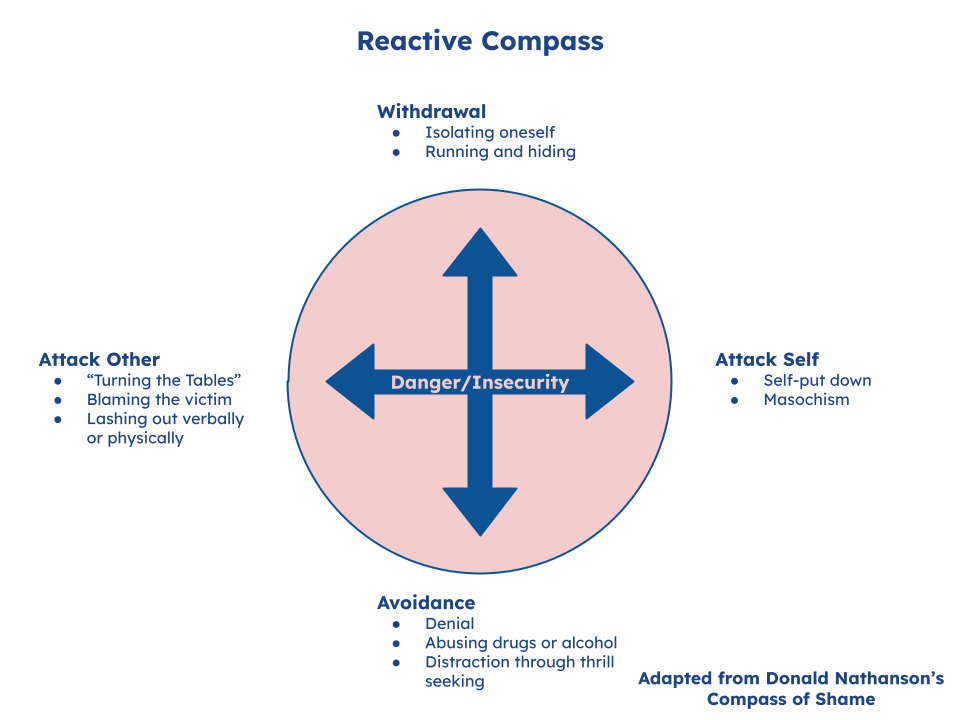
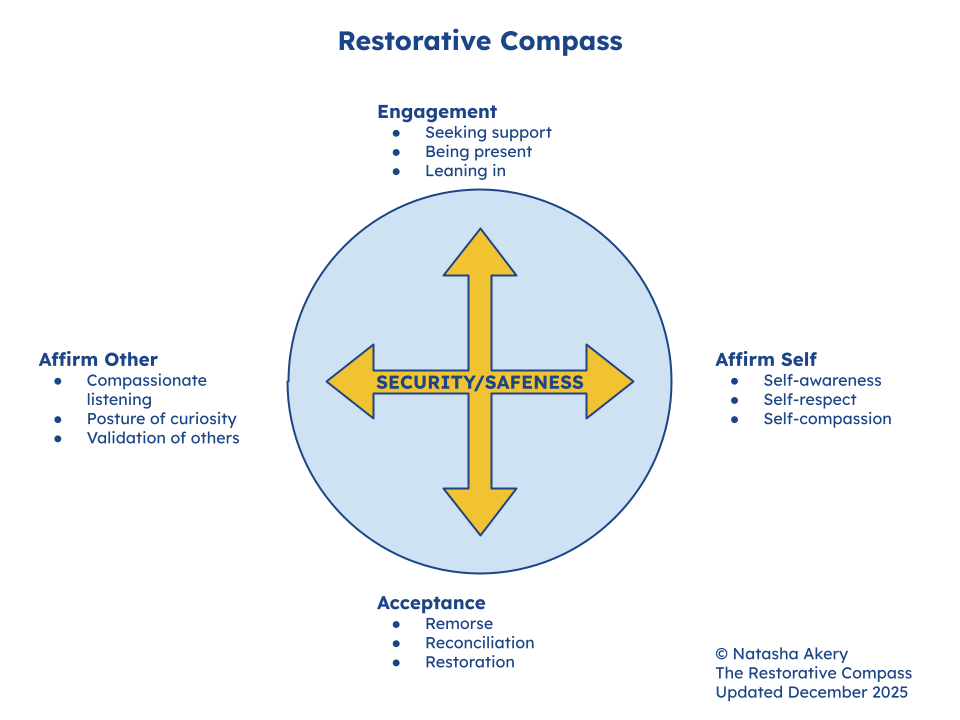
On the east side of the Reactive Compass is “attack self.” On the Restorative Compass, the action is “affirm self.” This includes self-awareness, self-respect, and self-care. These behaviors are important when others attack us. For example, a woman might yell at her husband for not taking out the trash or emptying the dishwasher. He could respond by putting himself down after his wife yells at him. He could call himself stupid for forgetting. He could tell himself that he is a terrible husband. If he responds restoratively, he can acknowledge his mistake without mislabeling himself. He can accept the fact that everyone makes mistakes from time to time. He might even acknowledge that his wife doesn’t need to yell at him.
On the south side of the Reactive Compass is “avoidance.” This includes denial, thrill-seeking, and substance abuse. On the Restorative Compass is “acceptance.” This includes remorse, reconciliation, and restoration. The husband could ignore the conflict, crack open a beer, retreat to his office, or leave the house. To be restorative, he can apologize. He can accept responsibility for the impact his mistake had on his wife. He can complete the tasks and seek to repair the harm he caused.
On the west side of the Reactive Compass is “attack other.” This behavior includes verbally or physically lashing out. On the Restorative Compass, the action is “affirm others.” This includes compassionate listening, being curious, and validating others. When we listen with compassion and curiosity, we gain another perspective. These behaviors also affirm another person’s experience. If the husband responds with “attack other,” he might yell in return or double down on not doing these tasks. If the husband responds with “affirm other,” he might listen beyond her yelling. He might consider that because he didn’t do his part, she can’t do her part. He might remember that this week has been busy for her.
On the north side of the Reactive Compass is “withdrawal.” This includes isolating oneself or running and hiding. These behaviors often overlap with “attack others” and “attack self.” The restorative opposite would be “engagement.” This includes seeking support, being present, and leaning in. The husband can resist the impulse to mentally or physically check out of the conflict with his wife. He can be present with her frustration and determine the best action. He can put a reminder on his phone for taking out the trash and emptying the dishwasher. He can choose to close the gap between them instead of widening it.
The Restorative Compass addresses the gap left by Nathanson’s Compass of Shame. What do we do instead of attacking others, attacking ourselves, withdrawing, or avoiding? Affirm others. Affirm self. Engage with others and self. Accept others and self. The Restorative Compass outlines behaviors that are difficult to choose but support relationships. These behaviors also reengage positive affect. Restorative practitioners can use the Compass of Shame and the Restorative Compass to address conflict and consider the next steps for restoring a relationship.
Language matters in restorative work. In the current version of the Restorative Compass, the term “affirm” is used in place of “acknowledge,” thanks to the careful consideration of my colleague Sandy Ruch-Morrin. Affirmation moves beyond recognition toward validation, dignity, and a sense of belonging. Also in this current version, the term “safeness” is used in place of “safety,” for which I am grateful to Dr. Frida Rundell. Safeness recognizes that being physically safe does not guarantee that someone is emotionally and psychologically safe. The update clarifies the ethical and relational posture the compass is intended to support. The Restorative Compass is a living framework and may continue to evolve as practice and reflection deepen.
How to Cite the Restorative Compass
Long-form (articles, syllabi, publications)
Akery, N. (2025). The Restorative Compass [Framework and diagram]. https://akeryed.com
Short-form (slides, handouts, workshops)
The Restorative Compass – Natasha Akery, akeryed.com.
 AkeryEd